Research-based review
Shokz OpenDots 2: What These Clip-On Earbuds Get Right
Published: · By Moda Selection editors
Open-ear earbuds make one promise that is easy to understand: your music comes along without shutting the rest of the day out. The Shokz OpenDots 2 try to make that compromise feel less like a compromise. The clever part is not simply that they leave your ear canal open. It is how little hardware they ask you to notice.

Official product image courtesy of Shokz.
How we researched this guide: Moda Selection has not conducted hands-on testing of OpenDots 2. We checked Shokz's published specifications against independent, hands-on reports from Tom's Guide, T3, Expert Reviews, and The Run Testers. That lets us separate the useful details from the launch-day adjectives without pretending the earbuds have been on our own ears.
Affiliate disclosure: If you buy through a link in this article, Moda Selection may earn a commission at no additional cost to you. Our assessment and the price you pay are not affected.
First, these are not bone-conduction headphones
That distinction is worth making because the Shokz name is closely tied to bone conduction. OpenDots 2 use air conduction. A small speaker sits near the entrance of the ear canal, while the battery section rests behind the ear and a flexible arc connects the two.
Your ear canal stays open, but the sound still travels through the air in the familiar way. The dedicated bone-conduction microphone mentioned in the specifications is there to help isolate your voice during calls; it is not how music reaches your ears. Shokz explains the design and signal path in its official OpenDots 2 specifications.
The fit is the real headline
At 6.4 grams per side, each OpenDots 2 earbud is light enough that weight should not be the first thing you notice. More important is the pressure of the clip. Too loose and an earbud shifts whenever you move; too tight and the back of your ear starts negotiating for a break before lunch.
This is where the independent reviews are unusually consistent. Testers at Tom's Guide wore them through workouts, office hours, and travel and found the hold secure without becoming distracting. T3's two-week test reached a similar conclusion, crediting the soft silicone and flexible JointArc for a clip that does not feel aggressively pinched.
That consensus is encouraging, not universal. Ears vary, and OpenDots 2 come in one flexible size rather than a set of interchangeable tips. Placement matters too. Slide the speaker slightly forward or back and both comfort and sound can change. The sensible first-day approach is to move them a little instead of assuming the first position is the only position.
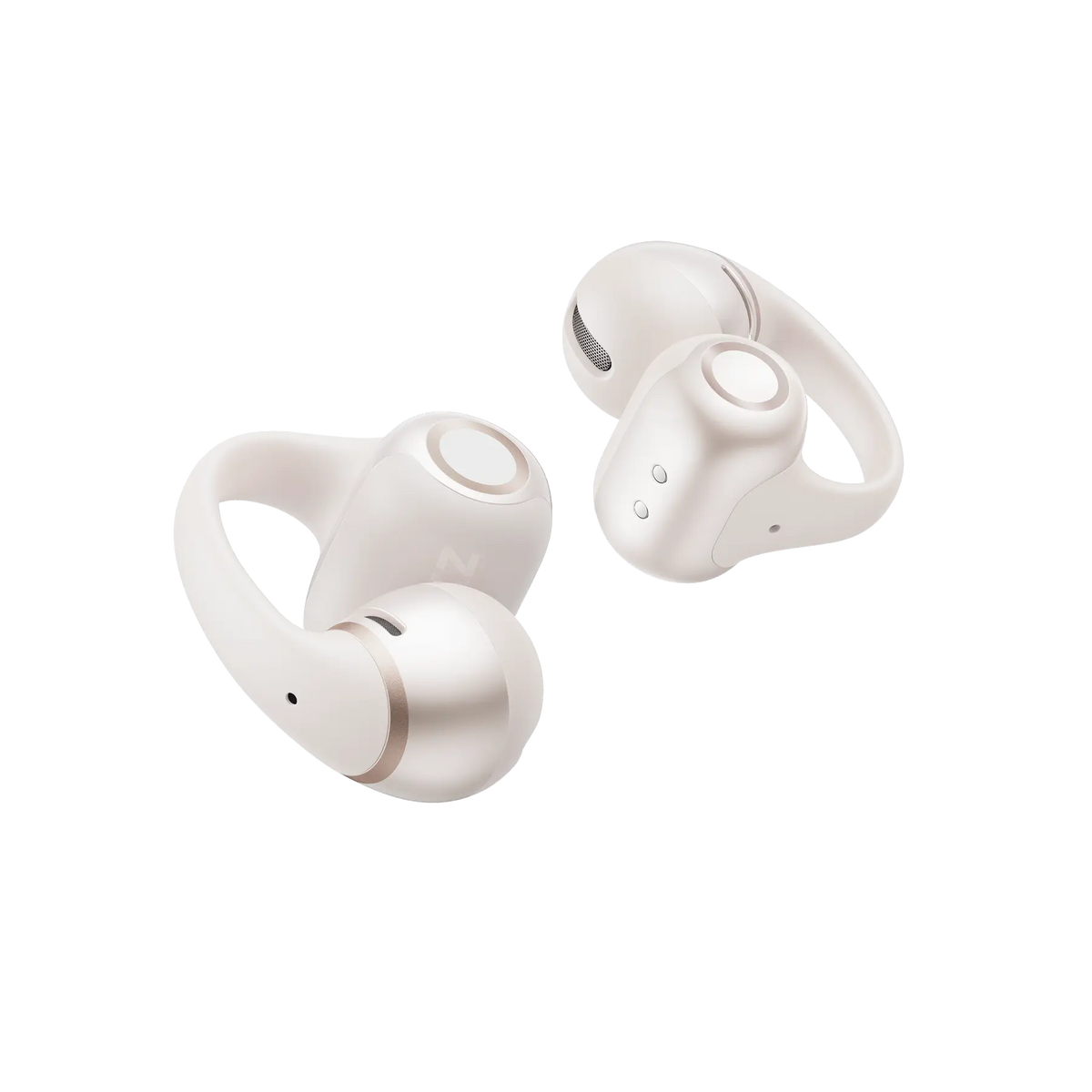
The speaker and battery sections are joined by Shokz's flexible JointArc design. Official product image courtesy of Shokz.
Open-ear sound has improved, but physics still gets a vote
Open-ear earbuds have traditionally asked for patience in the bass department. Without a silicone tip sealing the canal, low frequencies have more competition from the room, the street, and the general clatter of being alive. Shokz answers that with Bassphere 2.0, two custom 11.8 mm drivers, MirrorPitch and DirectPitch processing, plus an upgraded Dolby Audio mode.
Those names matter less than the pattern across the listening tests. The Run Testers' three reviewers regarded the OpenDots 2 as some of the strongest-sounding open-ear earbuds they had used, with enough flexibility in the Shokz app to make music and spoken audio feel properly filled out. Tom's Guide also found the presentation unusually full and clear at higher volumes.
There is still a ceiling. In a quiet room, on a walk, or during a normal run, the sound has space to be enjoyable. On a noisy train or plane, outside noise does not politely step aside. Tom's Guide found travel noise could overwhelm them, while T3 noted that wind at cycling speed made music harder to hear. That is not a defective version of open-ear listening; it is the bargain you are making.
For podcasts, lighter playlists, office listening, and outdoor exercise, that bargain can feel very reasonable. If the goal is to disappear into an album on a flight or feel the lowest notes rather than merely hear them, a sealed pair of noise-cancelling earbuds remains the more natural tool.
A small adjustment can change the sound more than a new EQ preset
The Shokz app offers Standard, Bass, Vocal, and Private presets, a manual EQ, and Smart EQ. Dolby Audio is available when you want a wider, more processed presentation. There is plenty to play with, but the first sound adjustment should be physical: make sure the speaker is aimed toward the canal.
Both T3 and Expert Reviews found that positioning or EQ could materially affect the result. That is useful to know before judging them in the first thirty seconds. Start in Standard mode, settle the clips into a comfortable position, and listen to something familiar. Only then decide whether the bass needs help or the upper range feels too bright.
Awareness is the feature, not a consolation prize
There is a particular relief in hearing a delivery at the door, a colleague asking a question, or a bicycle approaching without switching on a synthetic transparency mode. OpenDots 2 do that naturally because the ear stays open. For home offices, shared spaces, dog walks, and outdoor runs, this may be the reason to choose them rather than a compromise to tolerate.
Awareness is not absolute. Music at a high volume can still cover quieter cues, and an open design does not make distracted road use safe. Keep the level sensible anywhere traffic, announcements, or other people need part of your attention.

Open-ear listening is designed for everyday awareness rather than acoustic isolation. Official product image courtesy of Shokz.
Calls sound practical rather than studio-perfect
Each earbud uses two air-conduction microphones and one bone-conduction microphone, supported by adaptive beamforming and AI noise reduction. The aim is straightforward: keep your voice intelligible when the room or street is less cooperative.
Hands-on reports suggest the system largely succeeds at clarity. Tom's Guide callers could understand the tester in noisy settings, though they described his voice as slightly thin. That feels like the right expectation. OpenDots 2 should be useful for an ordinary work call or a conversation while walking, but “three microphones” should not be translated into broadcast-grade voice quality.
The controls are better when you pinch
Shokz combines taps with a force-sensor pinch. A pinch gives the fingers something definite to do and is less mysterious than tapping the side of your ear and waiting to see whether the music agrees. The controls can cover playback, calls, track changes, volume, and a voice assistant, with assignments adjusted in the app.
The reviews were more enthusiastic about pinching than tapping. T3 found the pinch reliable but the tap less consistent on a flexible ear. That is the sort of small detail that matters after the product-page excitement fades. If accidental or missed taps bother you, customize the gestures around the controls that behave most predictably.
The battery is easy to live with
Shokz rates the earbuds for up to 10 hours per charge and 40 hours with the case. A five-minute quick charge is rated for another two hours of playback, and the case supports both USB-C and Qi wireless charging.
Those numbers are strong enough that battery anxiety should rarely shape a normal day. Volume, call time, connection conditions, and audio settings can all change the real figure, but Tom's Guide found the official estimate held up well during its test period. One practical warning from the same review: take a second to check that each earbud is seated against the charging contacts when it goes back into the case.
They are made for movement, not swimming
The earbuds carry an IP57 rating, which is reassuring for sweat, rain, and dusty days. Independent running tests also found the clips stayed secure through exercise. They may shift slightly as the ear moves, but reviewers did not report the kind of loose, nervous fit that makes every stride feel expensive.
IP57 does not turn them into swimming headphones. Water resistance can also decline with wear, so the practical habit is still to dry the earbuds before returning them to the case and keep the charging contacts clean.
The small conveniences add up
Dynamic Ear Detection means there is no permanent left or right earbud; either one can work on either side. MultiPoint Pairing connects two devices at once, useful when a laptop call interrupts something playing on a phone. Fast Pair and Microsoft Swift Pair reduce setup friction, while Find My Earbuds, last-known-location support, and Drop Alerts offer a few ways to chase down a clip that has gone missing.
None of those features makes a dramatic advertisement on its own. Together, they make the OpenDots 2 feel less experimental. They behave like mature everyday earbuds that happen to sit differently, rather than a clever form factor still waiting for the basics.
Who should buy the Shokz OpenDots 2?
They are a strong fit for someone who regularly removes in-ear buds because of pressure, wants to hear the room while working, or prefers outdoor audio that does not seal away traffic and conversation. Runners and walkers should appreciate the combination of a stable clip, low weight, awareness, and IP57 protection. Glasses wearers may also find the clip format easier to share ear space with than a larger ear hook.
They are harder to recommend if your daily route is dominated by aircraft cabins, underground trains, loud machinery, or any environment where isolation is the entire point. They also will not satisfy someone chasing the deepest bass or active noise cancellation. At $199.95 at the time of publication, it is worth being honest about which side of that line describes your week.
Final verdict: a persuasive answer to earbud fatigue
The OpenDots 2 do not make open-ear audio identical to a sealed earbud, and pretending otherwise would miss why they are interesting. Their appeal is the absence of the seal: less pressure, more awareness, and a shape that can stay with you through work, a walk, and a workout without taking over the day.
The evidence from several independent tests points in the same direction. Comfort is the standout, the fit is secure, the sound is unusually substantial for the format, and the battery is genuinely convenient. The limits are equally clear: loud travel, strong wind, and listeners who want isolation remain outside their best territory.
If that sounds like a fair trade rather than a list of compromises, the Shokz OpenDots 2 are easy to understand—and much easier to imagine wearing regularly.
Frequently asked questions
Are Shokz OpenDots 2 bone-conduction headphones?
No. They use air conduction and place a speaker close to the ear canal while leaving it open. The bone-conduction component in this model is a microphone used to help capture your voice during calls.
Do Shokz OpenDots 2 have active noise cancellation?
No. OpenDots 2 are built around environmental awareness, not isolation. They are better suited to places where hearing the room or street is useful than to loud journeys where you want outside noise removed.
Can you wear OpenDots 2 for running?
They are designed for movement, carry an IP57 rating, and were found secure in several independent running tests. As with any open-ear product, keep playback low enough to remain aware of traffic and other hazards.
How long does the battery last?
Shokz states up to 10 hours per charge and up to 40 hours with the case. A five-minute quick charge can provide up to two hours of listening under the company's test conditions.
Can you use only one OpenDots 2 earbud?
Yes. Shokz says either earbud can be used alone for music or calls, although some app functions may be limited when only one is active.